Tuesday, May 25, 2010

Five Years Added to Student Leader's Sentence

By Ba Kaung (May 25, 2o10)

Kyaw Ko Ko made three dramatic escapes, but his luck finally ran out in 2008, when Burmese authorities arrested him for his role in the 2007 Saffron Revolution and he was sentenced to three years in prison for possesing illegal videos.

On Friday, with his first sentence set to expire in one year, the junta tacked on an additional five years for illegal asociation and subversion.

Kyaw Ko Ko delivers a speech to students in Rangoon during the 2007 Saffron Revolution.

Rahul Kyaw Kyaw Maung, alias Kyaw Ko Ko, 28, is the son of school teachers in Rangoon's Tamwe township. In 2006, he was in Rangoon studying for his masters degree in economics when he was recruited by former political prisoners to engage in political activities.

“Though he received some influence from other individuals, he himself is well-read, calm and disciplined,” recalled a political activist who met Kyaw Ko Ko a few years ago.

Kyaw Ko Ko met the prominent 88 Generation Students' leader Min Ko Naing in a monastery, where they were celebrating the anniversary of the student-led uprising in 1988. When Min Ko Naing and other 88 Generation Students' leaders were re-arrested for their protests against the unannounced increase in fuel prices, and many former political prisoners consequently fled Burma for fear of persecution, younger activists like Kyaw Ko Ko stepped in to take a leadership role.

Representing the new generation of activists that has emerged since since the nationwide anti-government uprising in 1988, Kyaw Ko Ko attempted to rejuvenate the Burma Students' Union, which had became active again during the 1988 uprising.

Although not an officially outlawed association, the Students' Union had become virtually illegal since the 1962 military coup, despite the fact that it played an important role in the country's independence struggle.

“At the court on Friday, my brother did not deny that he tried to reorganize the student's organization, but he insisted to the judges that the organization is a legal organization,” said Kyaw Ko Ko's sister.

When the Saffron Revolution broke out, Kyaw Ko Ko continued his dissident leadership role, and after the crackdown on protesting monks, he went into hiding in and around Rangoon.

In October 2007, a house in South Okkalapa township that Kyaw Ko Ko was hiding in was raided. He managed to escape by jumping off the balcony, but some of his friends were arrested.

Later, the police discovered him in a Rangoon monastery where he had been given refuge, but again he managed to escape. He eluded the authorities for a third time when they raided a snack bar in Rangoon's Junction 8 Shopping mall where he was meeting with friends, who were all arrested.

Kyaw Ko Ko fled to Pegu, but returned to Rangoon in early 2008 to launch a no-vote campaign against the referendum over the junta's controversial Constitution. Before the referendum was held, however, he was finally arrested.

The authorities found videos of the 1988 uprising in the place where Kyaw Ko Ko was hiding, and although family members said he had nothing to do with the videos, in 2009 Kyaw Ko Ko was sentenced to three years in jail after being convicted of violating Burma's Video Act, which regulates uncensored videos, and sentenced to three years in jail.

Violation of the Video Act is one of the charges the regime used in handing down a heavy prison sentence to Burma's famous comedian Zarganar, who is currently jailed in a remote prison.

On Friday, following a trial that was not covered by the state-controlled media, Kyaw Ko Ko received an additional five-year jail sentence for unlawful association and subversion, which according to his defense lawyer, Aung Thein, he is alleged to have committed during the monks' protests in 2007.

“He gave a speech to the crowds in 2007 in front of the Rangoon city hall while representing the students, and this entails the first charge of unlawful association. The same fact becomes the basis of the second charge for subversion,” Aung Thein said. “I believe this is nothing but an attempt to lengthen his prison term.”

“I am not frustrated. I will try to survive the prison life,” Kyaw Ko Ko told his sister during his Rangoon court appearance last week.

The 2007 Saffron Revolution saw the arrest and incarceration of other young activists in Burma, such as blogger Nay Phone Latt and hip-hop singer Zay Yar Thaw, who joined their activist predecessors in jails across the country.

And 2007 was not the first time Burma's young activists have been persecuted following the 1988 uprising. In 1998, many young dissidents were arrested and given long prison sentences, some exceeding 50 years. Many of these activists are still behind bars, according to the Thailand-based Association of Assistance for Political Prisoners in Burma (AAPP).

Currently, while the regime is preparing to hold Burma's first election in twenty years, more than 2000 political prisoners are estimated to be in jails across the country. Under the regime's election laws, all of them are barred from the voting process and do not have the right to be a member of any political party.

“My brother is against the election this year. He has no faith in this at all,” Kyaw Ko Ko's sister said.


Reference:

Kaung, Ba. Five Years Added to Student Leader's Sentence. The Irrawaddy. May 25 2010. http://www.irrawaddy.org/article.php?art_id=18554&page=2


Tuesday, May 18, 2010

USDA's hypocracy

This picture corresponds exactly what USDA (Union Solidarity and Development Association) is doing.

Reference:

Lay, Harn. Disciplined Democracy's Dry Run. The Irrawaddy. May 18, 2010.

Friday, May 7, 2010

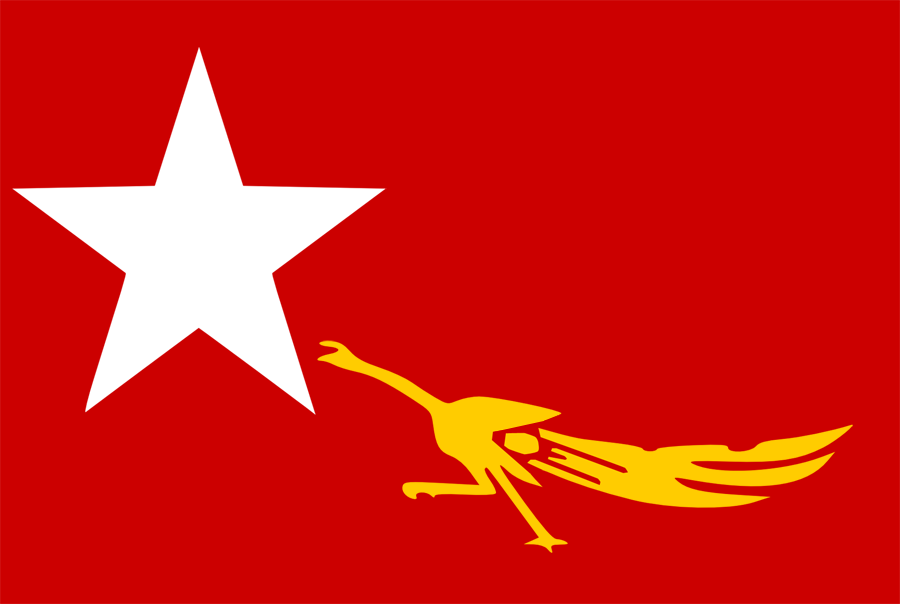
Fighting Peacock Flag is our emblem

Fighting Peacock Flag is an ABFSU's emblem and was a NLD's flag. It was and must be used solely by students of ABFSU but should not be used for any political purposes: good or bad.

I, as a student activist from ABFSU, condemn both Ye Htun of "FAKE" 88 Generation Student Union of Myanmar (GSUM) and Aye Lwin of Union of Myanmar Federation of National Politics (UMFNP). Since both of you are students of 88 Generation, you should have known that it is strongly prohibited to used for any benefit. And I believe both of you have become military dogs after being put behind bars. I also conclude that your intentions of using our emblem is detrimental.

If you believe in yourselves, you can create and use your own. DO NOT USE OUR FIGHTING PEACOCK FLAG AT ANYTIME, YOU IMPOSTORS!!!


Feathers Fly Over Use of Fighting Peacock Image

By Ko Htwe (May 7 2010)

Feathers are flying in Burma over the use of the fighting peacock emblem by two newly registered political parties in their election campaigns.

The emblem—famously associated with the now disbanded National League for Democracy (NLD)—has served as a national symbol since the days of the Burmese monarchy and was a rallying image brandished by student activists in colonial times.

“It's not appropriate to use the student movement's flag as the symbol of a political party,” said prominent journalist Ludu Sein Win, one of a group of about 40 people in the Burmese media world who signed a letter of complaint to the Election Commission.

“The fighting peacock symbol is not the property of a certain organization and it is associated with all Burmese nationals,” said Ludu Sein Win.

The Election Commission has ruled that it will accept objections against the use of flags or symbols by registered political parties.

The fighting peacock symbol is being used by two newly registered parties, the Union of Myanmar Federation of National Politics (UMFNP) and the 88 Generation Student Union of Myanmar (GSUM), led by two brothers who are former political prisoners. The two are the subjects of unsubstantiated suspicions that they are collaborating with the regime.

Objectors point out that the fighting peacock symbol adopted by the two new parties is similar to the one used by the All Burma Federation of Student Unions (ABFSU), which played a key role in Burma's independence movement against British colonial rule.

Since the 1962 military coup, the ABFSU has been viewed by successive regimes as an illegal organization. Its building on the Rangoon University campus was destroyed in a bomb attack in the year of the coup.

The ABFSU objected to the use of the peacock symbol when it was first adopted by the the now-defunct NLD and used in its party flag, but later dropped its objection.

“The ABFSU flag is being used only in the movement led by students, handed down from one generation to another,” said Myo Myint Nyein, of the Rangoon-based weekly journal The Ray of Light. “I don't agree with using it as the image of a party.”

GSUM chairman Ye Tun said his party and the UMFNP were only trying to trying to preserve the image of the fighting peacock.

The group of objectors agreed in their letter to the Election Commission that the symbol was “crucial for the history of the nation” but said “it should not be the property of any political party.”

Among the signatories of the letter of complaint was Maung Wun Tha, a veteran writer and editor who was a member of the ABFSU before 1962.

Reference:

Htwe, Ko. Feathers Fly Over Use of Fighting Peacock Image . The Irrawaddy. May 7 2010. http://www.irrawaddy.org/article.php?art_id=18419

Thursday, May 6, 2010

Thein Sein, if you have done nothing wrong and believe in yourself, what are you afraid of?


Burma’s censorship board is keeping a tight control on reporting in private journals about the junta’s Union Solidarity and Development Party (USDP) led by Prime Minister Thein Sein. Journalists in Rangoon said the censorship board, the Press Scrutiny and Registration Division under the Ministry of Information, does not allow any questioning on the controversial formation of the USDP, which was formed directly from the state mass organization, the Union Solidarity and Development Association (USDA). -- Irrawaddy

Again... Why is Thein Sein afraid off? Is he frightened that people might be focussing on his corruptions? Why is the Censorship Board preventing journalists to write critical comments although Thein Sein is no longer a Military official?

Answers to these questions are obvious. Although the War Office announced that Thein Sein's retirement, he is still acting as a Premier without a doubt. His party USDP, which is hated by citizens the most, involved in beating monks in Saffron Revolution. The corruptions in this election will be evident by the victory of USDP.

Hopefully, United Nations would not approve the outcome of this election. If UN or the World's Nations approve the result of election, it means that these Nations approve the massacre of Saffron Revolution in September 2007 and these nations will have proved themselves to be the same as Burmese junta.

Reference:
Moe, Wai. Tight Censorship on Reporting USDP. The Irrawaddy. May 5 2010. http://www.irrawaddy.org/article.php?art_id=18388

Burmese Generals deceive US Assistant Secretary of State for Public Affairs


WASHINGTON — Speaking at a daily press briefing on Tuesday, the assistant secretary of state for public affairs, P J Crowley, suggested that if Burmese generals resigned from the military to contest the upcoming election, this could be seen as a positive step.

Even Assistant Secretary of State for Public Affairs was deceived by the sly actions of Military Junta. Do you really believe these Burmese generals resigned for good or for the well-being of Burma? Of course not!

These generals are resigning because they have to cope with the unjust rules of 2010 Election written by themselves and because they want other countries to think they have become innocent. Even prime minister, Thein Sein, has stood down from his super position to take part in 2010 Election. If this is not the greediness, then what is it?

One thing for sure is that these resignations are not POSITIVE in all senses!


Reference:
Jha, Lalit K. Generals Resignation for Election May Be Positive. Irrawaddy. May 5 2010 http://www.irrawaddy.org/


Wednesday, May 5, 2010

The annihilations of Democracy Icons in Burma

NLD has been forced to disbanded. Ms. Suu Kyi is still under house-arrest. Students and opposing politicians expressing their views are put into jails.

If you ask where Democracy is now, I am very confident to say that it does not exists in Burma. Burmese military junta is trying its best to brush off any obstructions for them from the surface of the earth. By obstructions, I am referring to Democracy icons such as the peacock flag, Ms. Suu Kyi, NLD, and so on.

Although NLD is dissolved by force, the peacock flag which is a representative of our student body and a Democracy Icon, will vanish by no means, and we will protect our peacock flag with all our hearts!!!

Sunday, May 2, 2010

Dirty laws of Burma Election 2010

The National League for Democracy (NLD) will cease to exist as a political movement after the deadline for party registration on May 6, according to NLD Central Executive Committee (CEC) members. The Burmese opposition party refused to re-register for this year's general election, saying the election laws were “unfair and unjust.”

-- Irrawaddy

Unfortunately, NLD had fallen into the dirty tricks of Military Government. With NLD's declaration of refusal to take part in the election, Military Government immediately announced a new rule for the election -- "all parties which took part in 1990 election must register for 2010 election or they will be disbanded".

What an "unfair and unjust" move! Like I speculated, this Military junta has always been craving to wipe out the name "NLD" from the surface of the earth.

Students, monks, and opposing political parties are the only groups which dare to express their beliefs towards everything, and thus are targets of this cruel regime. DON'T FORGET that a lot of students had been massively annihilated since 1988 uprising, monks were beaten to death in September 2008, and politicians, especially from NLD, are still in jail.

Is this what Democracy is? Definitely not!!! This is a pure dictatorship of the suppressive regime which always wants to clear anything in its way.


Reference:

Htwe, Ko. NLD Will Cease To Exists. The Irrawaddy. May 1, 2010 http://www.irrawaddy.org/

Tuesday, April 20, 2010

Persecution of Chin people


What is persecution?

Persecution is the systematic mistreatment of an individual or group by another group. The most common forms are religious persecution, ethnic persecution, and political persecution, though there is naturally some overlap between these terms.

Reporters from BBC covertly went to a village of Chin people who are being mistreated and abused in all ways. The culprits of these persecution are Burmese Troops, the puppets and "dogs" of military junta.

BBC team was guided to the village by military-blacklisted Chin activist Ms. Zahau. The words of Ms. Zahau, "If we don't speak up, if we don't tell the stories of the people under this repressive military regime, then no-one will know what's happening, and if they don't know they will not do anything," grasp the heart of many people over the world.

People from Yangon (formerly known as Rangoon) have not heard of these stories for a long time because of the government's total control of media in Burma. Television, Newspaper, Journals, Magazine, and all kinds of media, except Internet, are regulated by military officials. Even Internet is blocked partially sometimes.

The regime systematically banned the watching of news over the world via satellite by increasing the tax rates of possessing the satellite receivers (in Burma, even if you buy the satellite with your money, you still have to pay tax to the government). Since the average salary of middle-class people are low due to inflation, the general public has no idea what is going on far from the city, Rangoon.

The systematical persecution of the military regime is very treacherous. Nobody ever has such twisted brain as the junta since history. Hitler is just a fly compared with the bat-like junta.

Although Hitler was notoriously vicious and cruel, Hitler did not do any harm to his people. Burmese military government do not care about Burmese people, instead they live on citizens' "sweat and blood" (according to Burmese saying).

If the regime successively mistreats Chin people for their difference in climate, religion and views, more Chin people will move to India. If most of the people from Chin State move to India, that means Burma has lost its land, a State. If Burma lost a state, we have to change our beautiful national flag with fourteen stars which represent fourteen states. So, we, Burmese people, should make people from all over the world know about Chin people's lack of human rights... right now!!!


Reference:

Bagnall, Sam. Burma's 'forgotten' Chin people suffer abuse. BBC. Apr 19 2010 http://news.bbc.co.uk

Wikipedia. http://en.wikipedia.org/wiki/Persecution

Chin Women Organization http://www.chinwomen.org

Thursday, April 15, 2010

BLAST IN BURMA? WHO MIGHT CAUSE IT?


http://news.bbc.co.uk/2/hi/asia-pacific/8622068.stm

In the very secure city of Rangoon, my hometown, there was a huge blast this morning, causing 9 casualties and at least 30 wounded people. (according to BBC)

In fact, total of 59 man and 16 woman were injured, according to resources.

Today is the most sacred holiday called Thingyan for Buddhist people. In this water festival, people play water from 13th April to 16th April in order to celebrate this sacred holiday. The purpose of Thingyan is to clear the sins from last year and be a new person with new soul and body.

However, Military government banned building of Pandals ('mandat' in Burmese or 'pavalions') around the city since last 4 years, allowing people to build Pandals in a big road called Inyar Road where most of the higher-ups from military live. Do they not want people to clear their mind and body? May be they don't.

Surprisingly and sadly, Military government banned building of Pandals even in Inyar Road this year. As Thingyan is important for Burmese people, Pandal coordinators decided to build near the Kandawgyi, which is one of the most famous place in Rangoon.

A lot of people went there for celebrating the festival. What did they get? They got bombed. Isn't it too obvious that the military government deliberately moved the festival area to the place where the higer-ups do not live?

And don't forget that in September the military government shot monks, the most sacred persons for Buddhists and for people in Burma. So, it is not a surprise that the junta won't even care about the people under their reign.

But what makes me think this way?

There will be a so called election in October where many political parties will get involved, except NLD which got highly supported by Burmese citizens.

In 1990, NLD won the election by high percentage of support but the military government cheated the ballot counts and made fake ballots of their own. They overruled the election and took the position of the head of the state by force.

Talking about history, there was also bombing before the referendum in 2008. And the bombing was very close to the City Hall which had a very tight security. Who else can get near city hall without permission from the military? Who else can diffuse the bomb near the city hall? I could think of no one, except the military junta.

But why? Why did they want to plant the bomb near the city hall? They just tried to scare people and wanted to win the election in dirty way.

Back to present, IT IS HAPPENING AGAIN!!! They want to get the "Seat at the United Nations" which is taken by NLD by scaring people. Without a doubt, the junta will definitely blame and link these bombings on NLD in a few days.

My guess is there will be more terrorist activities in coming months in order to discredit NLD. And of course, they are using such "control-by-scaring" tactics to baffle the minds of the citizen and hoping to get the reason to disband NLD.

After all, their goal is to wipe out the name, "NLD", from the surface of the earth and rule over the country with the dirtiest tricks.


Reference
BBC News http://news.bbc.co.uk/2/hi/asia-pacific/8622068.stm
CNN News http://www.cnn.com/2010/WORLD/asiapcf/04/15/myanmar.blast/index.html?iref=allsearch